Squad HQ: warehouse, shop, hiring and the memorial
What a player does between battles: fireteams, the warehouse and shop, one recruit and veteran market for everyone, and a memorial for the fallen and missing.
A battle in Terminal Leave lasts a few minutes; a squad lives for weeks. Between battles the wounded heal, gear gets repaired and restocked, the dead are replaced, and someone has to decide who goes next. All of that happens in the squad headquarters. This post is about what it is made of and why it works the way it does.
Seven tabs
The first HQ was a single page with everything on it: soldiers, gear, the battle button. With six soldiers and a couple of rifles that was fine. Once the warehouse, the shop and hiring arrived, the page stopped fitting, and I split it into tabs. On a phone you switch them by icon or by swiping.
Home is where a battle starts: the mode, the map, and the fireteam that goes.
Roster lists every soldier, each with a dossier: portrait, country, stats, weapon skills, awards, and a list of battles from which you can open the results and the replay. This is also where a soldier is dismissed.
Loadout is the gear grid, which had a post of its own.
Warehouse holds everything the squad owns that is not issued to a soldier. Weapons and armour here are not abstract “+1 accuracy” items: every piece has its own serial number and wear.
Shop sells weapons, armour and ammunition, and buys, repairs and strips for parts whatever came back from battle. Not everything is for sale: clothing and exoskeletons are never stocked — you take them off an enemy.
Hire and Memorial get sections of their own below.
Fireteams
A squad can have up to a hundred living soldiers, but six go into a battle. So that you don’t rebuild the line-up before every fight, the squad is split into three fireteams of ten. Order within a team matters: the first six who are able to fight are the ones who go. A soldier below half health is skipped and the next one in the list takes the place. The last four of a team are, in effect, a reserve that fills gaps without the player having to do anything.
A team can be given a name and a symbol. The dead and the missing drop out of their teams automatically, so a line-up with a dead man on it never goes into battle.
One recruit market for everyone
Recruits are not made at the press of a button. The server keeps a single market for all players, and every recruit on it is a specific person with a name, a face, a country and stats. Only one player can hire him: once hired, he is gone from everyone’s list.
The market is topped up once an hour. It always holds at least a hundred recruits: if they are hired down, the server brings the count back to that floor. On top of the floor it adds a buffer — but only if someone hired during the past hour, and each buffer is half the previous one: 50, 25, 12 and on down to one. Without that rule the market would either run dry when many players are online or pile up hundreds of people nobody wants when few are.
A recruit’s price rises with his stats. A new recruit has no callsign — that is earned in service, no earlier than the third battle. Portraits rotate: a new recruit gets the face that has gone unused the longest; a plain random draw kept handing out the same face several times in a row.
A shared market leads to one simple thing: a good recruit is rare not because a drop chance says so, but because someone else may have hired him first.
Veterans
The hire tab has a second list — the veteran market. It holds soldiers with a past. A dismissed soldier who has been in at least one battle does not vanish: he goes to this market, and another player can hire him. So does a soldier left wounded on the field, once he has healed and decided to look for a new commander. And so do the survivors of the computer opponent’s squads.
A veteran comes with his whole biography: battles, awards, rank, who he served under before and how he left. That is why he costs more than a recruit — the price adds up from rank, level, battles fought and awards.
The memorial
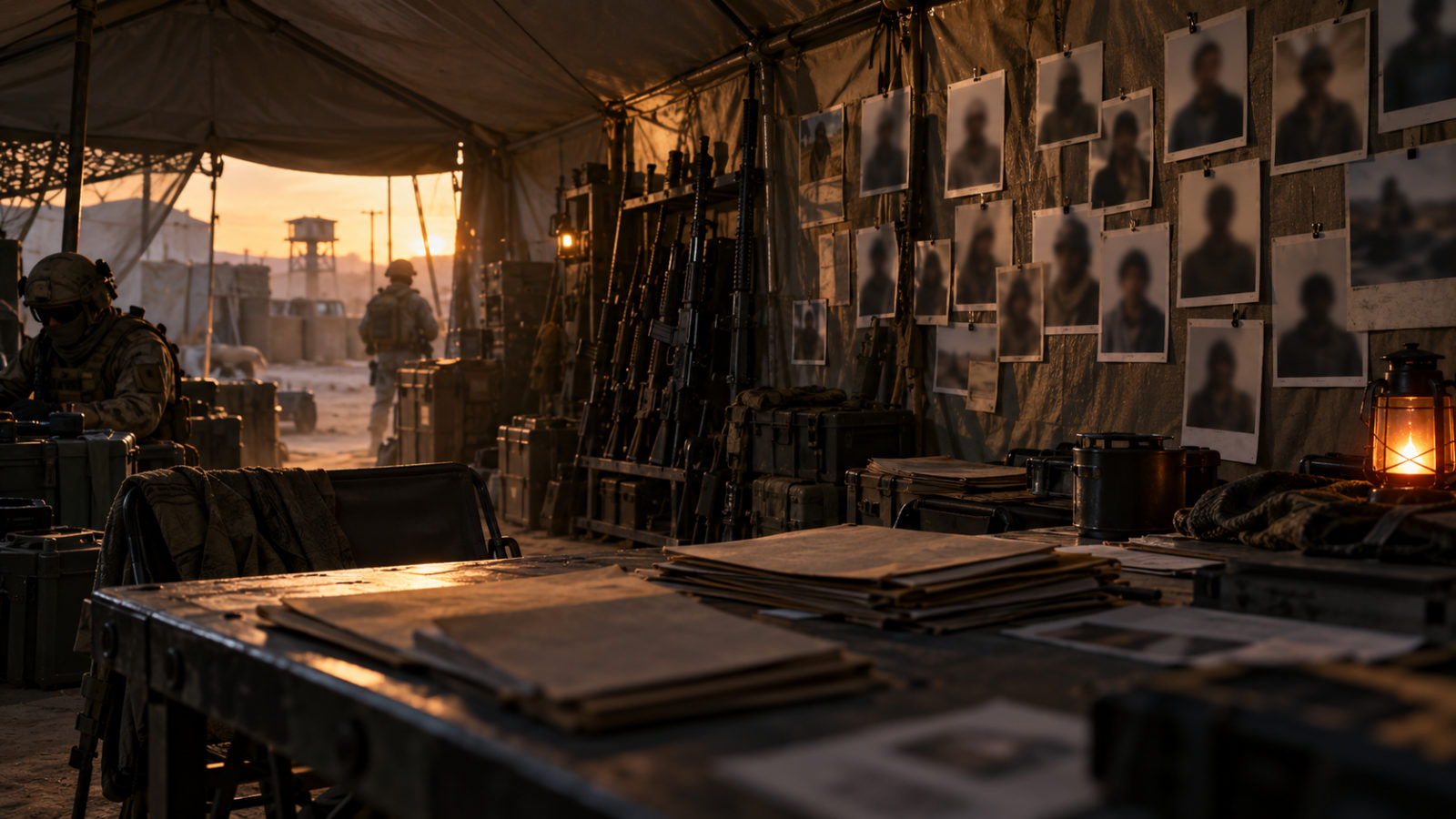
Fallen soldiers are not deleted. They move to the memorial with their whole history: where they served, what they were decorated for, the battle they died in. A memorial dossier is the same as a roster one, and it opens the results and replay of any of their battles the same way.
The missing in action have their own place on the memorial. Missing is not dead, and the card does not disappear once the soldier’s fate is known. If he came back to the squad, the card turns green. If he turned up on the veteran market, it turns yellow: he is alive, but no longer willing to serve you. Those cards can be removed; a fallen soldier’s card cannot.
A soldier can be marked for “Eternal memory”, including right on the results screen of the battle he fell in. Marked soldiers stand in a block of their own above the rest of the list. It is the simplest tab of the HQ and, to my mind, the most important one: a loss stops being a line in a battle report. More on persistent soldiers in “Every soldier has a face”.
What is still rough
A shared market works best when there are many players. In the closed alpha there are still few, and competition for recruits is barely felt: hardly anyone hires through a floor of a hundred. The market size can be changed from the admin app, and I will tune it as the player count grows. Another gap is captivity: a soldier taken prisoner by the enemy still reads as plainly missing to his former commander, and the memorial says nothing about it.
Play the demo battle — no signup needed — then save your squad and open the HQ.