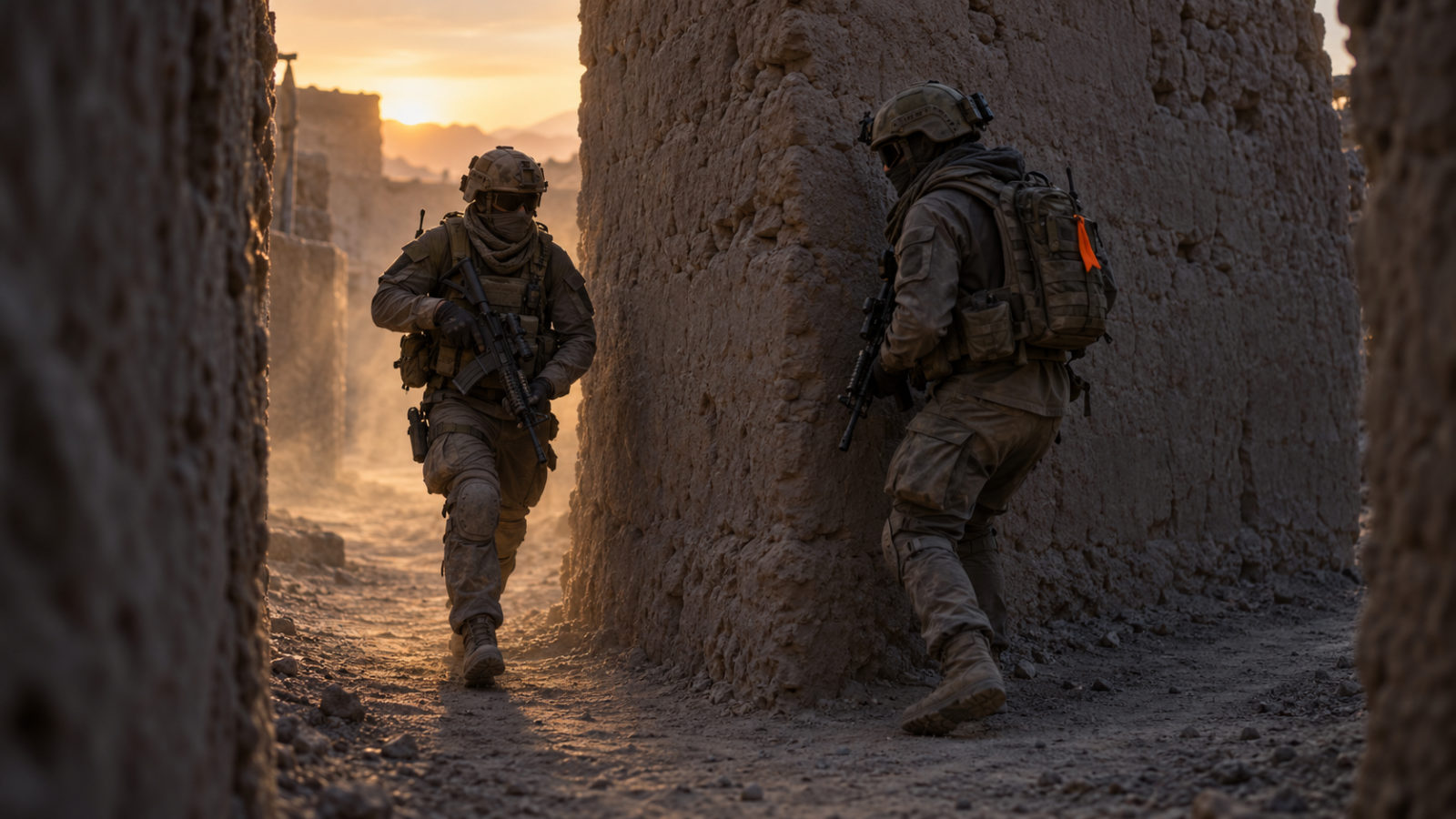
When two routes cross
What happens when two soldiers head for the same tile at the same moment, and how per-weapon fire modes and an aiming reticle with hit chance appeared.
With alternating turns two soldiers can’t end up on the same tile: the second simply can’t go there. With simultaneous turns both players plan without knowing the other’s route, and collisions are inevitable. Early on (the project was called UOR then) a rule for them appeared.
Giving way
A tile holds one soldier. It belongs to whoever steps into it first on the round’s clock. The other stops in front of it and checks every 0.15 seconds whether it has cleared. If it clears within 0.6 seconds, he goes on along his route. If not, he gives up the rest of the route and stays where he stopped.
Sometimes two soldiers reach a tile in the same millisecond. Then the one who comes earlier in this round’s order goes first. The server shuffles that order anew every round, and the shuffle depends only on the battle’s seed. When an order reached the server plays no part in it. Otherwise the advantage would go to whoever has the faster connection, and a replay could drift from what actually happened.
A special case is two soldiers walking towards each other, each needing the other’s tile. Under the general rule both would wait for each other and both would give up. So such soldiers simply pass: they swap tiles in one step.
The rule treats your own men the same as the enemy. Two soldiers of one squad sent through the same door won’t get stuck in it: one goes through, the other waits.
The delay in that case is a fraction of a second, but on a shared timeline it is real. The soldier who gave way comes round the corner later than planned.
Fire modes
Weapons got fire modes around the same time. Before that there was one kind of shot for every weapon. Now each has its own set: single, snap, aimed, burst — depending on what kind of weapon it is.
Modes differ in time, ammunition spent and accuracy. An aimed shot takes a noticeable part of the round. A snap shot is quicker than a normal one, but less accurate. A burst uses more ammunition: in effect it is three shots in the time one takes, but each of them is less accurate. Choosing a mode is choosing between “hit” and “make it in time”.
The reticle and turning
For planning fire there is now a reticle: hovering over an enemy shows the chance to hit, taking into account range, fire mode and cover. The soldier’s vision cone is drawn on the field, so you can see what falls within the sector.
The right mouse button now turns a soldier to face the indicated tile. Turning is a separate action with a cost of its own, and it often has to be given explicitly: a soldier who has reached a corner looks where he was walking, not where the enemy is expected from.
Where it stands now
Later it turned out that 0.6 seconds was too little among comrades: a soldier gave up his route although the man ahead was about to move out of the way. Now a soldier waits as long as it takes for a comrade who will still move this round, and steps around one who has stopped for good. Of two comrades, the one whose route was given later waits, and the planner shows that wait in advance on the round’s timeline. An enemy is still waited for 0.6 seconds, and then the soldier tries to go around.