Callsigns, ranks, skills and medals you sign off yourself
How a Terminal Leave soldier got an identity kept by the server, and a rifle got a serial number and a history of its own.
A soldier used to be just a set of stats — a row of numbers in a table. Now each one has an identity — a name, a callsign, a rank, skills and awards — and the server keeps it. Even a rifle got a serial number and a history of its own.
What a soldier’s identity is
Every soldier has a first and last name, a country, a callsign and a rank. All of it is data on the server, not a label the client draws.
A callsign can be changed. A rank is given by the commander — by hand, not when a counter is reached. Ranks could have been automatic or manual, and I settled on manual: a rank in a squad is the commander’s regard for a soldier, not a number of battles.
Skills
Besides general stats a soldier has weapon skills — separately by type. They grow with use: whoever fights with a submachine gun gets better with it. There are no levels, and no experience points to spend wherever you like.
After every battle the player sees exactly what changed for each soldier. Why it is done this way is explained in the article on progression without levels.
Awards
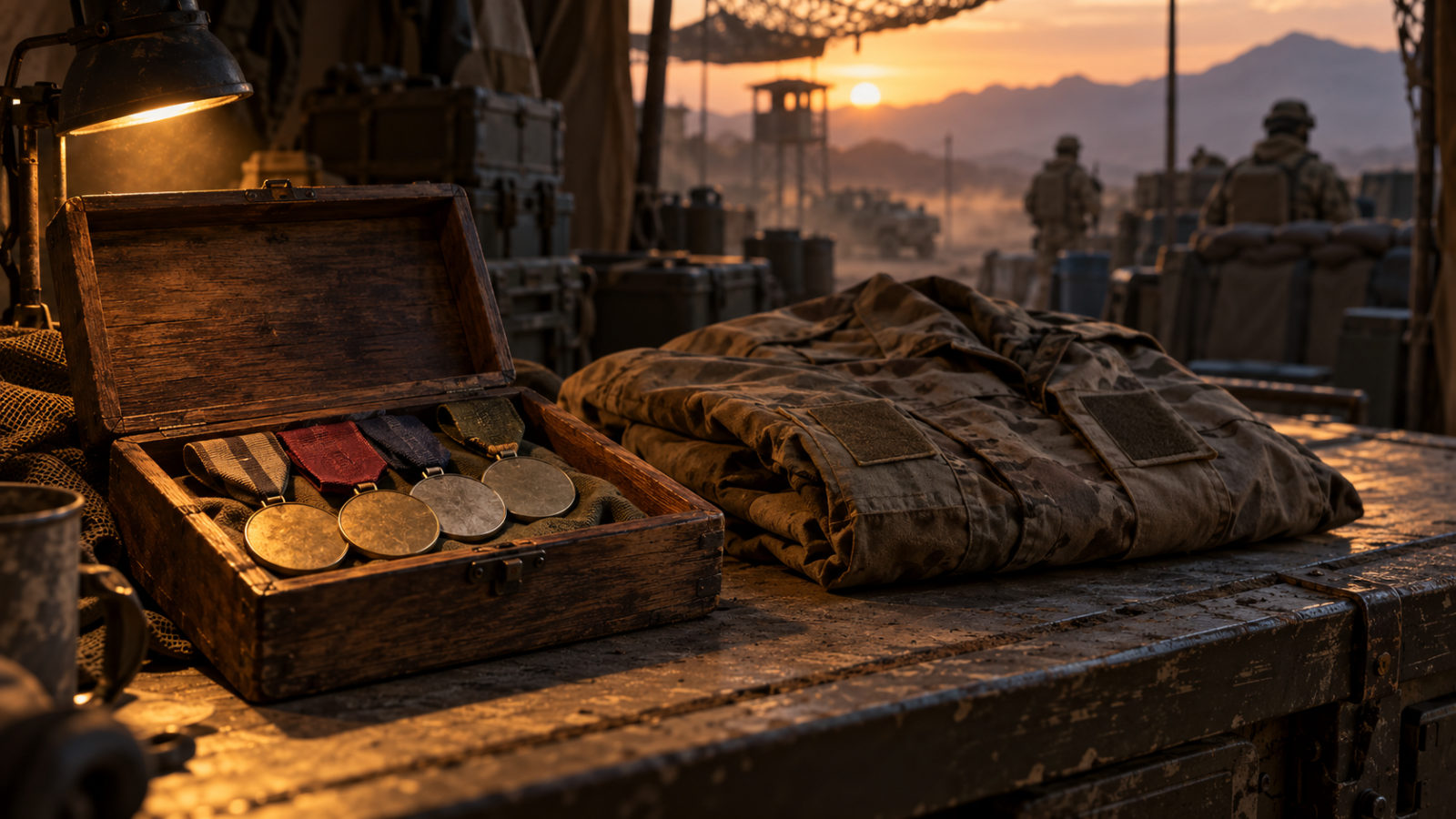
The server tracks what a soldier did in battle and, when an award’s condition is met, nominates him. It does not award. The nomination goes to the commander, who decides: approve or reject.
That is deliberate. A medal that dropped by itself is an achievement from a list. A medal you signed is a decision. A commander who approves everything devalues his own awards, and the game doesn’t stop him.
A weapon with a serial number
Equipment changed at the same time. A “rifle of such-and-such model” in the warehouse used to be just a quantity. Now every rifle and every armour vest is a separate instance with its own serial number, condition and statistics: how many shots fired, how many hits, who owned it.
An instance can be given a name of its own.
Together with the rule on losing equipment this gives the situation all of it was built for: the rifle your veteran carried through twenty battles can end up in the enemy’s hands — the very same one, with the same number and the same history.
What isn’t there yet
In the design, soldiers also have loyalty and relationships with one another. The groundwork was laid then too, but they don’t affect combat yet.