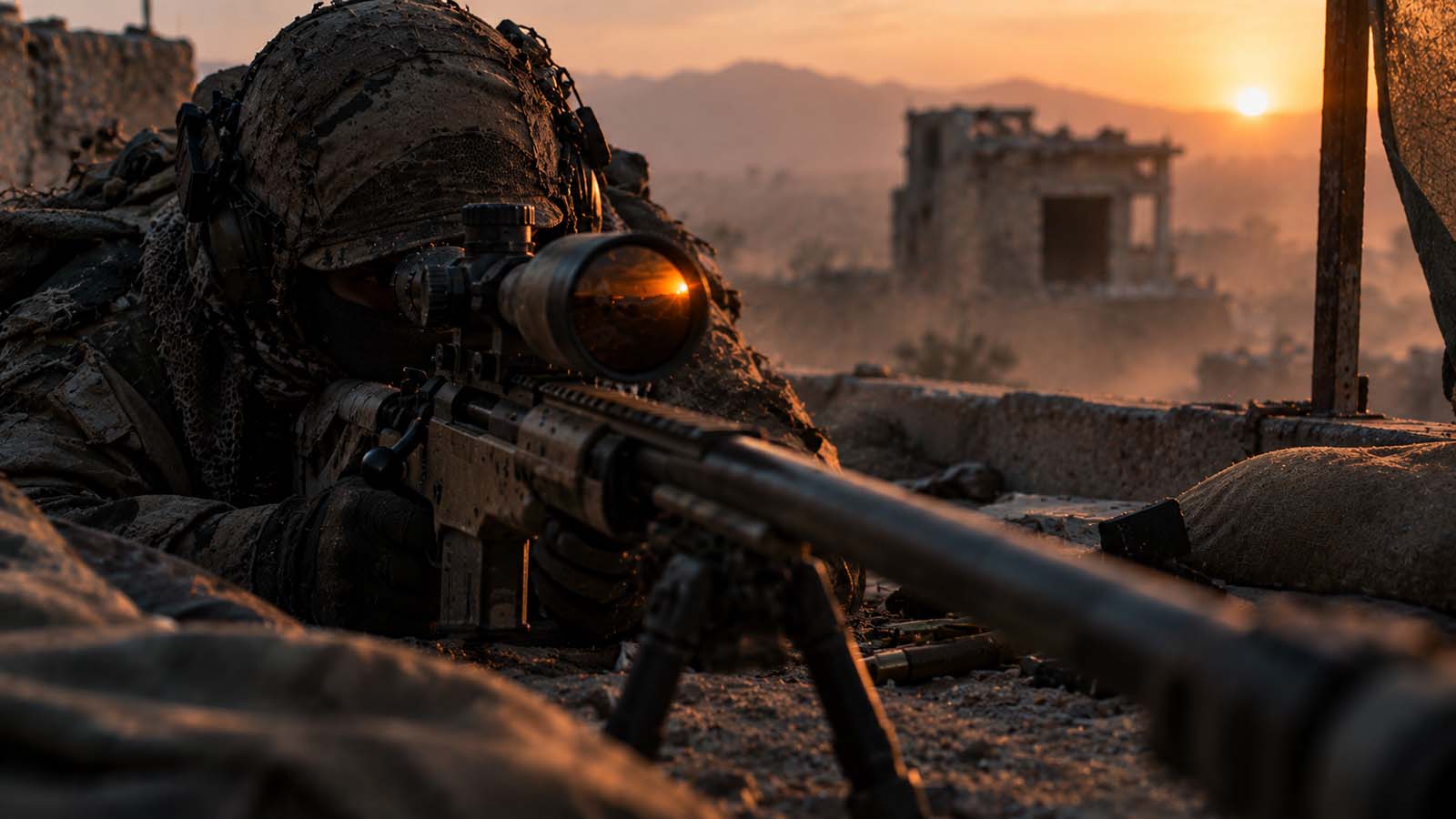
A burst is not three accurate shots: how gunfire works
Aimed vs snap fire, bursts, suppression on a tile you can’t see into — what goes into every shot.
Gunfire in Terminal Leave isn't a “65% to hit” tooltip. Here's what a shot is actually made of.
Every gun has a personality. The catalog currently holds 17 weapons — from pistols to sniper rifles, including a full SMG lineup. Each has its own base accuracy, range, weight and fire modes. An SVD and an M24 are two different tools, not “same gun, different damage”: the SVD aims for three seconds and can fire twice a round, the M24 aims for four and fires once. The SVD pays for that tempo with less range, accuracy and damage.
A shot takes time. An order to fire is not instant. An aimed shot from a rifle takes two seconds of the round, and the bullet leaves at the end of them. A snap shot is shorter — the bullet leaves sooner, but flies worse. Rapid fire stacks a shot-after-shot penalty that only resets when you stop and aim. Fast and accurate at once — doesn't exist.
The target can leave while you aim. The shot is checked at the moment it comes, not when the order starts. If by then no one on your side sees the target — it stepped behind a wall, dropped out of sight — there is no shot. Sniper rifles aim the longest, and they lose targets this way more often than anything else.
Every bullet of a burst is worse than the one before. The hit is rolled for each bullet separately, and every next one gets a penalty of its own gun: an M4A1 barely climbs, an AKM throws its third bullet well off. A burst puts more lead out, but it is three chances that get worse, not three accurate shots.
Shooting from behind a corner. A soldier behind a corner can lean out, fire and lean back in one order. While he is out, he is in half cover and his shot is a little less true than from open ground. If the round would end before he gets back, he doesn't lean out at all — no one is left hanging in the open. There is a counter to it: a sniper aiming at a soldier behind a corner fires the moment that soldier leans out, without waiting for the full aim — the earlier the soldier leans out, the less the sniper has aimed, and the less true the shot.
Skill makes a soldier faster, not only more accurate. Skill with a class of weapon grows from using it, and it shortens the order itself: at the top of the skill the order takes less time, and the shot comes earlier — well before the order ends. In the same exchange a veteran has already fired while a recruit is still aiming. Reloads get shorter too.
The bullet is a physical object. It travels along a ray through specific tiles: it can lodge in a thin wall, punch through a window, or hit someone you weren't aiming at. Flight renders as per-tile tracer dots — you can read an entire firefight from the tracers.
You can shoot at nothing — and that's tactics too. The shoot-at-cell command lets you hose down a bush, a window or a corner where you merely suspect an enemy. The server resolves every bullet along its ray: suppression, stray hits, cover destruction. No line of sight to the target required — just like real life.
All of this is already in the game. Try it in the demo battle: play the demo battle.