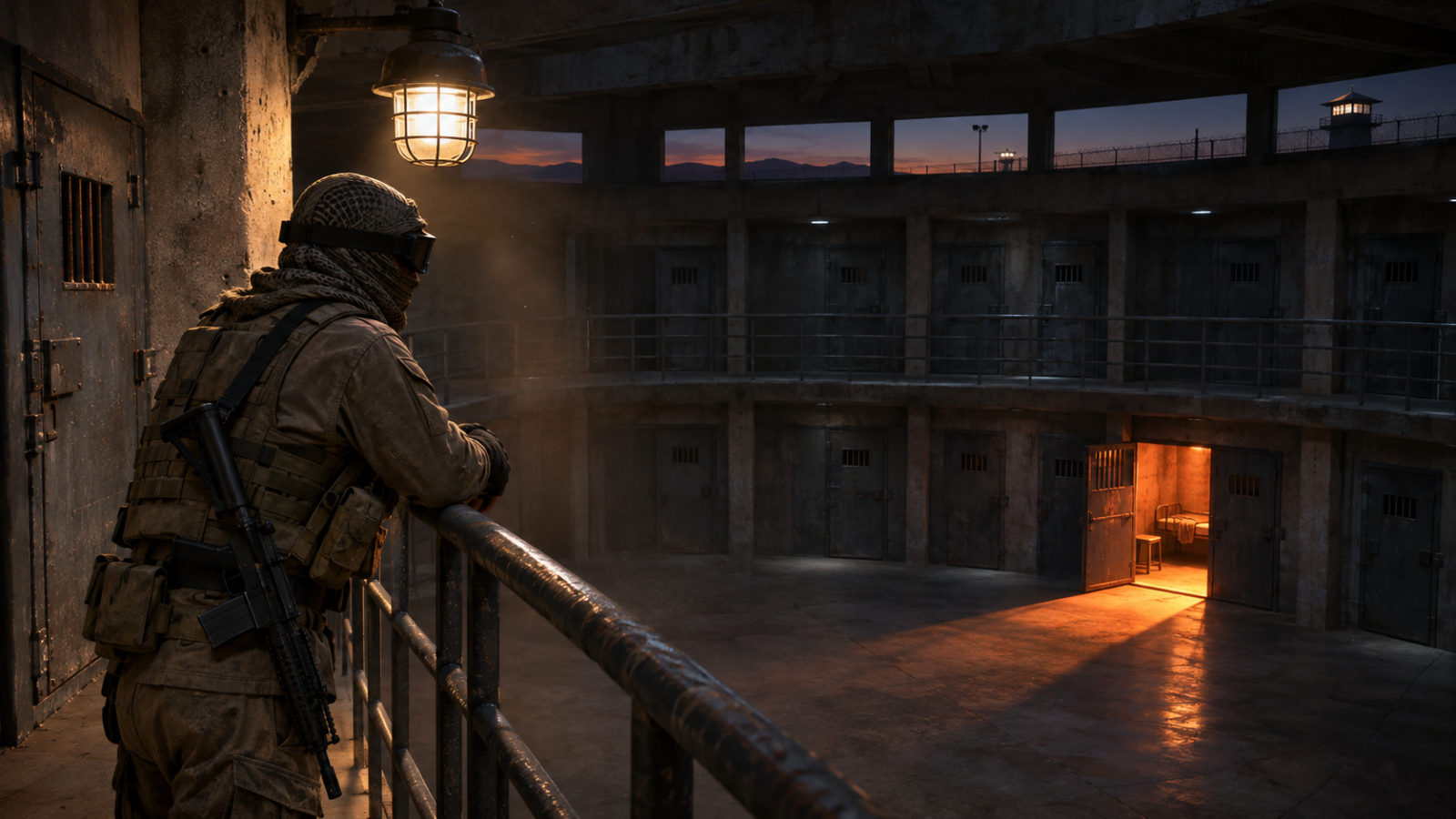
Captivity: the prison at your base, interrogations and investigations
How a soldier gives up or is captured, what happens to them in someone else’s prison, and how the former commander searches: investigation, ransom, escape.
Before version 0.4.0 a wounded soldier left on the field simply went missing, and then either recovered and joined the veterans or died. There was nothing between those two outcomes. Now there is a third, and it brings a whole piece of the game with it: a prison at your base, interrogations, work, investigations and battles for your own people. The block has been open to every account since 8 November, and this is the first attempt to describe it in full.
How a soldier is captured
The winner takes the badly wounded enemies lying in their evacuation zone or carried on their soldiers’ shoulders. A side that lost or drew takes only those it carried out itself. Anyone simply left on the field isn’t captured.
A soldier can also give up. The first way is an order: one button, and it can be cancelled until the round starts. The soldier drops the weapon on their cell, raises their hands and can walk with them raised. One who gave up by order and isn’t tied can pick the weapon up from their cell again, so giving up works as a trap too. The second way is fear. Once a side has lost more than half its people, and noticeably more than the enemy, the server rolls every round whether a soldier raises their hands without an order. Courage, wounds, losses, unhealed PTSD and a commander who has left the battle all feed that roll. One who gave up from fear won’t take up arms again.
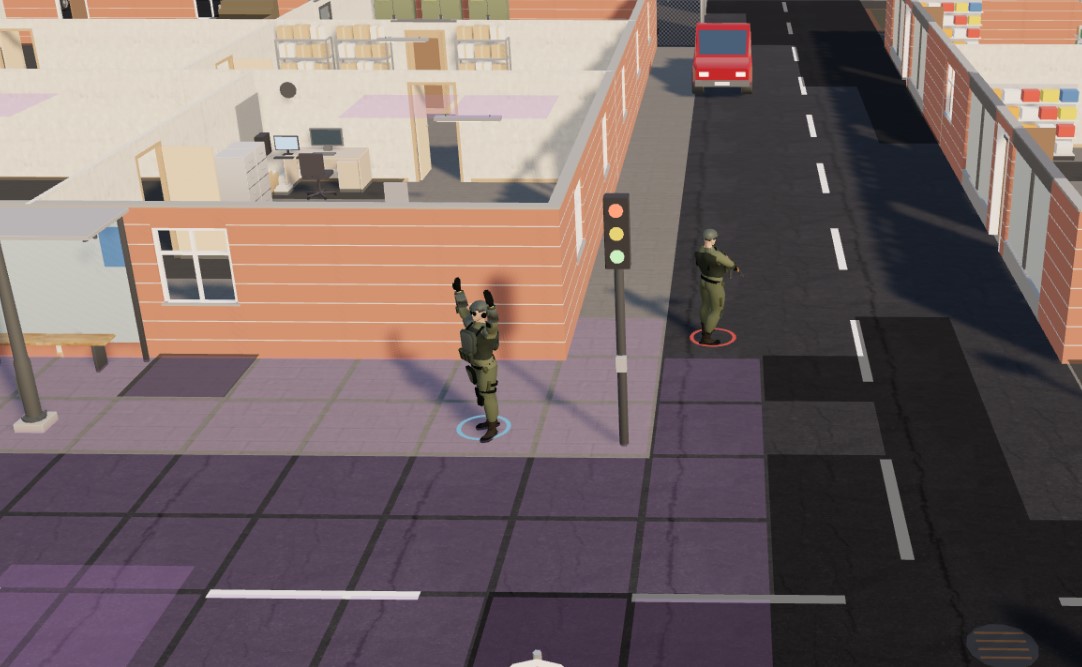
An enemy can tie a surrendered soldier by stepping up close: they then kneel until the battle ends. Shooting them takes a direct order; overwatch doesn’t fire at those who surrendered. Such a killing isn’t counted and pays nothing. If the surrendered soldier’s side wins, they stay in service; if the enemy wins, they are a prisoner. A surrender is visible only to whoever sees the soldier, and says nothing about how many enemies are left. Nobody gives up in the demo battle.
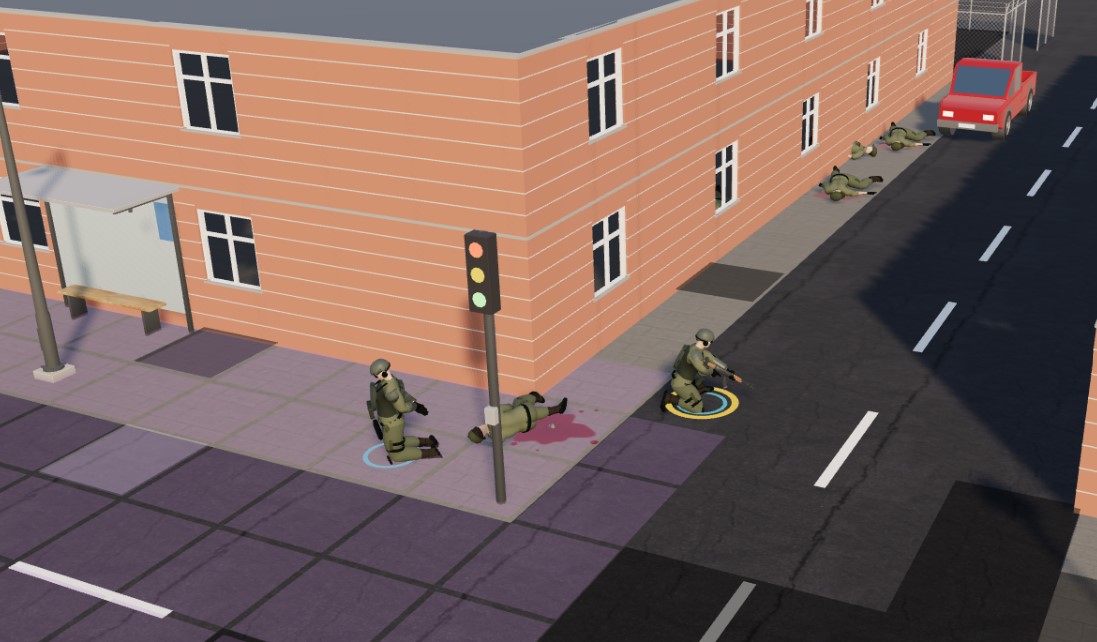
The badly wounded
What happens to the badly wounded nobody carried out changed at the same time. They used to be “finished off” at random. Now such a soldier either dies of their wounds at once or spends a day or two in a hospital, and the healthier they were, the better their chance. After the hospital they come back to their commander, appear on the veteran market, vanish, or go home to their village. “Finished off” now means one thing only: the winner really did finish them off after the battle.
The prison at your base
Every base has its own prison, twenty cells, one prisoner each. If there is no room, after the battle you are offered to kill or release, and if you choose nothing the prisoner is released. It is a 64 × 64 map of its own: four wings of cells round an atrium, interrogation rooms, a mess, an exercise yard and a gatehouse with gates. Prisoners live by a daily routine and wear orange robes.
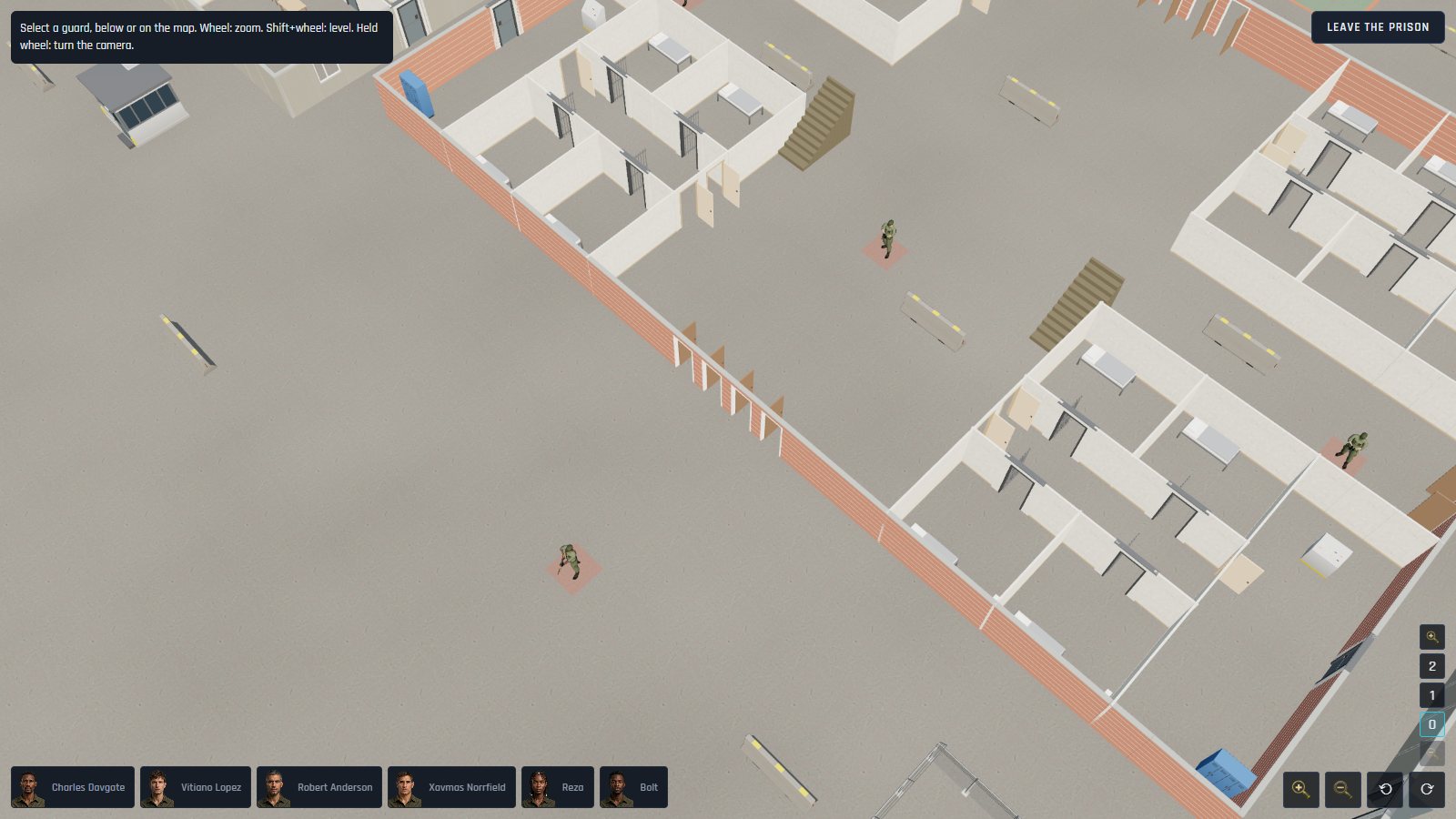
The prison is guarded by one assigned fireteam, up to six posts. These are ordinary soldiers; they can go to battle, heal and run interrogations, only each absent one raises the risk of an escape. The risk is shown on the home screen by a colored light.
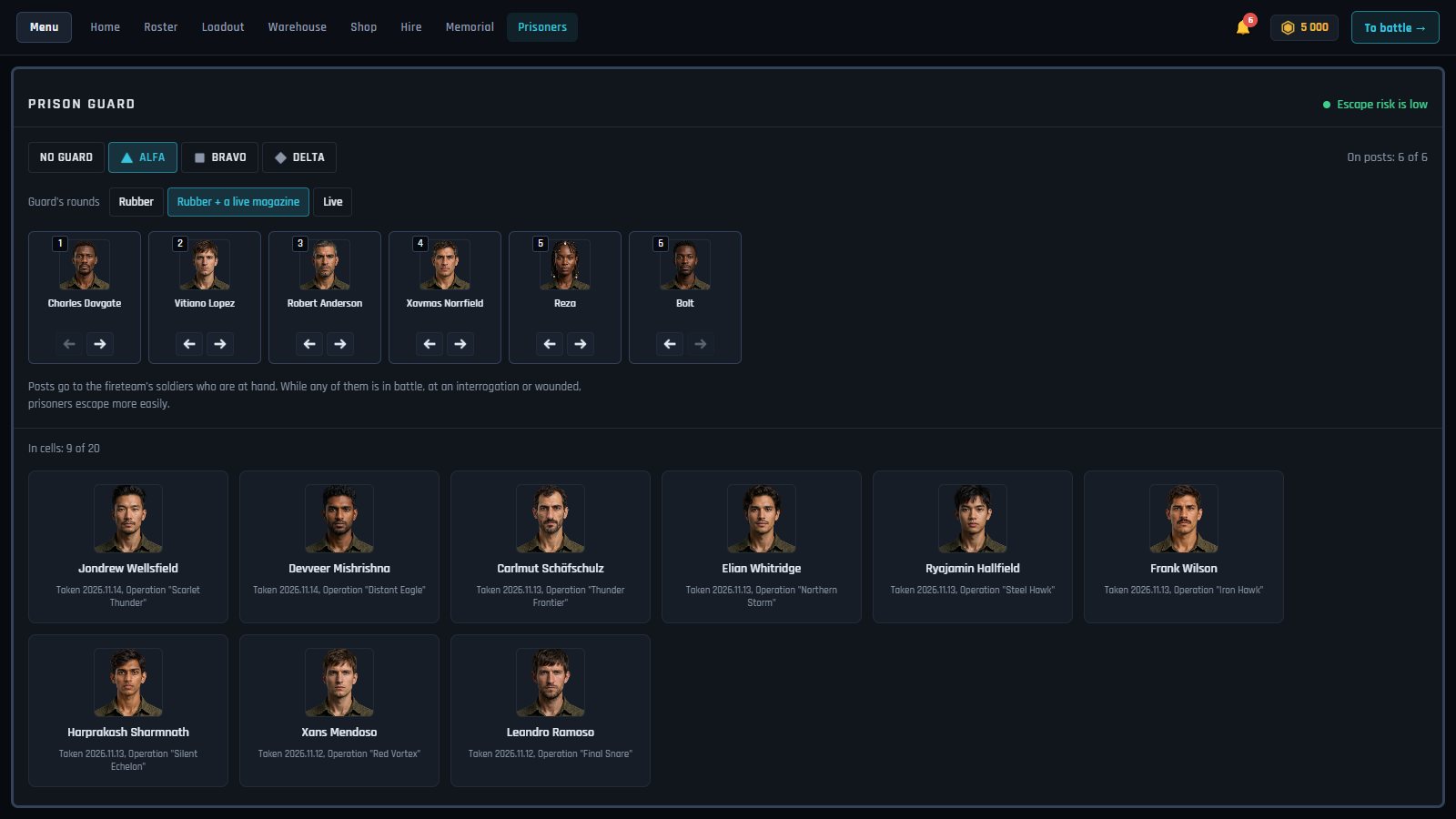
Prisoners can be sent to work in the workshop. It has two shifts, morning and afternoon, ten places in each, and every working prisoner brings the prison’s holder 2 credits an hour. A prisoner can be put on both shifts, but in the second they bring half as much and are twice as likely to escape. There is also a punishment cell: in it a prisoner drops out of the routine and loses one point of courage a day, until it is down to half of what it was. Why you would want to break courage becomes clear a little further down.
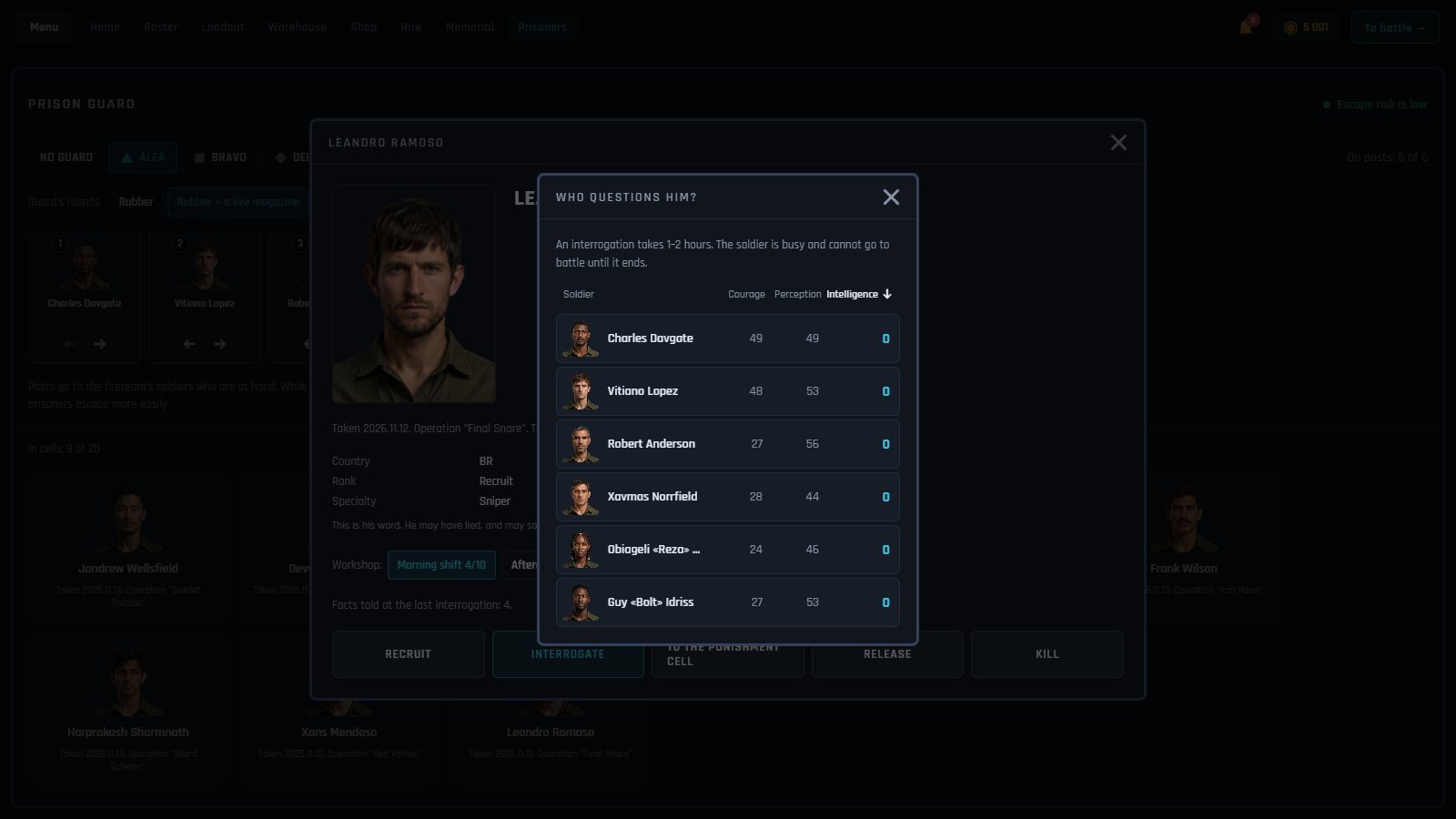
A new prisoner is closed: a photo and a number, nothing else. The rest comes from interrogation. Any free soldier of the base can run one; it takes an hour or two and can be repeated every six hours. The outcome is decided by the interrogator’s courage, perception and the new skill, intelligence, against the prisoner’s courage. The surer the success, the more facts the prisoner gives: name, callsign, country, age, rank, specialty, former commander. Any of them may be a lie, and the player doesn’t know which; a repeat interrogation can replace an old fact with a new one. Once in a while a prisoner breaks and tells everything as it is.
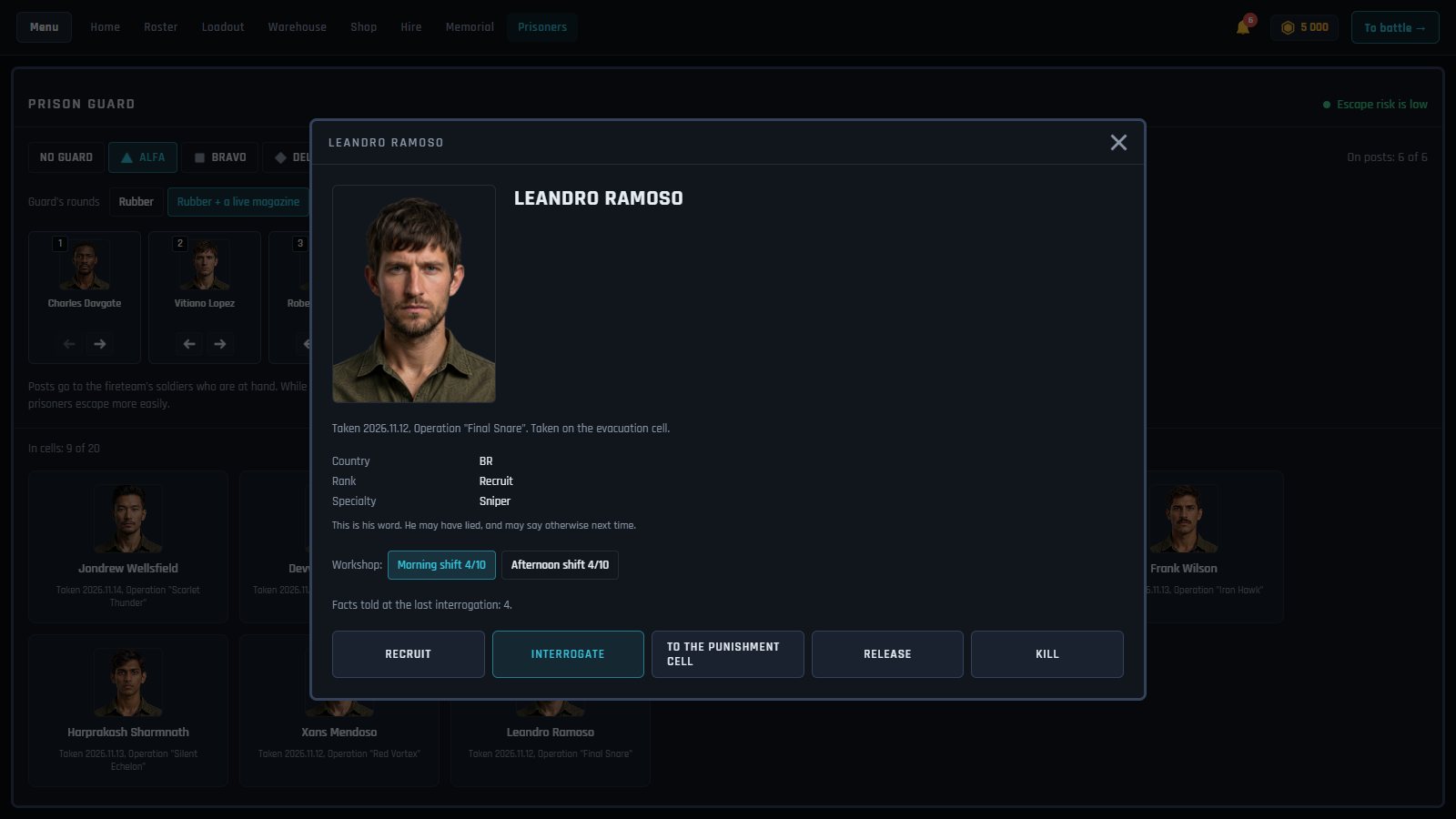
You can try to recruit a prisoner once a day, and the lower their courage, the better the chance: that is what the punishment cell is for. A recruited soldier joins your base, while their former commander still sees “missing in action”. A released one heals and goes looking for a new contract among the veterans. A killed one is recorded as killed in captivity.
A prisoner may also break out on their own, unarmed and at half health. The escape is played as a battle on the prison map: the guards stand at their posts until the runner is spotted, and the prison’s holder gets a notification and can take the guard under control; until then the AI commands it. Guards are loaded with rubber and carry one live magazine each; whether to switch to it is the player’s call. A runner who reaches the way out goes home; one who is caught goes back to the cell.
What the former commander sees
Nothing. To them the soldier is missing in action, the card in the memorial is silent, and neither interrogation nor work nor recruitment nor killing changes it. That is deliberate: otherwise the card would give away someone else’s actions for free.
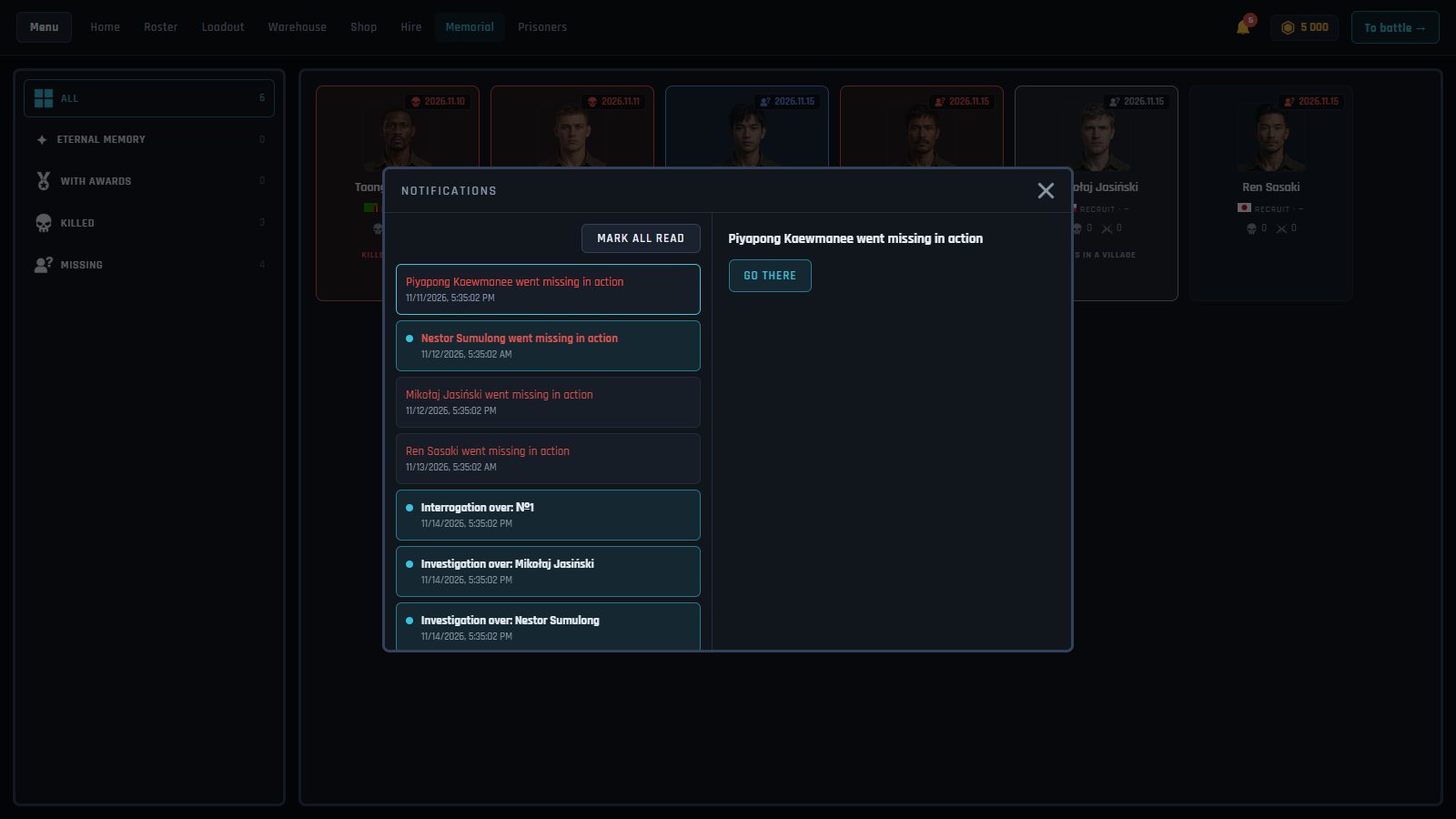
An investigation is how you find out: the card of a missing soldier has an “Investigate” button. The commander assigns a soldier, pays and waits; for now that is half an hour, a test value. The investigation can fail and find nothing. If it succeeds, the card gets a frame and a line: blue if the soldier is held by so-and-so, red if they died or were finished off on the field, grey if they settled in a village. They may also be recovering before they reach the veterans, or have vanished under someone else’s passport. There is nothing more to investigate about the dead and the vanished. A “held” card doesn’t change on its own afterwards, whatever happens in that prison.
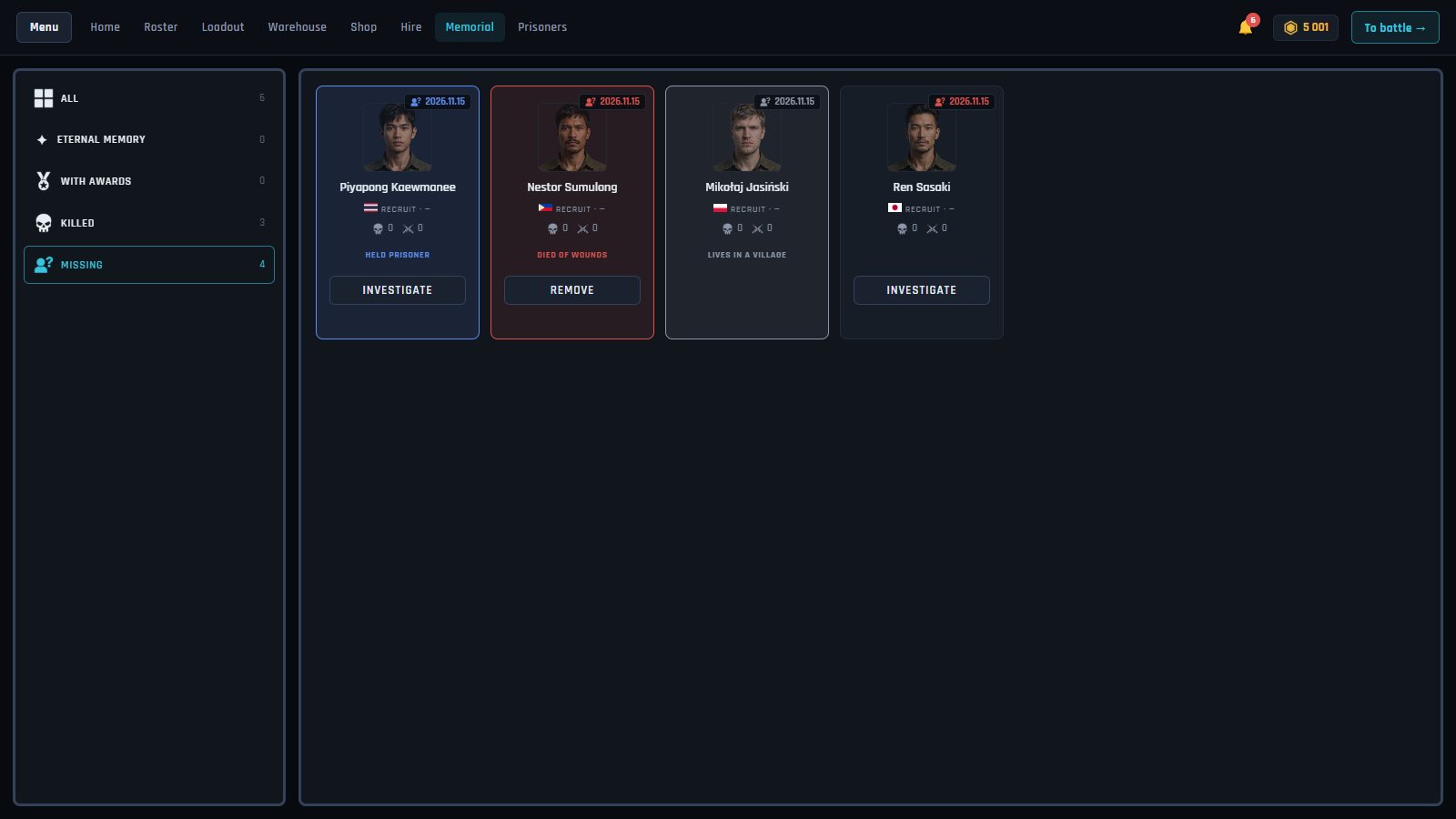
The memorial is now split into the fallen and the missing in action, the service history records captivity and the return from it, and a notification about a missing soldier or a finished investigation opens the card of the soldier it is about. A card can be removed from the memorial once the soldier has come back, turned up among the veterans or been found dead; while nothing is known, it stays.
Getting your soldier back
Once you know where the soldier is, there are three ways.
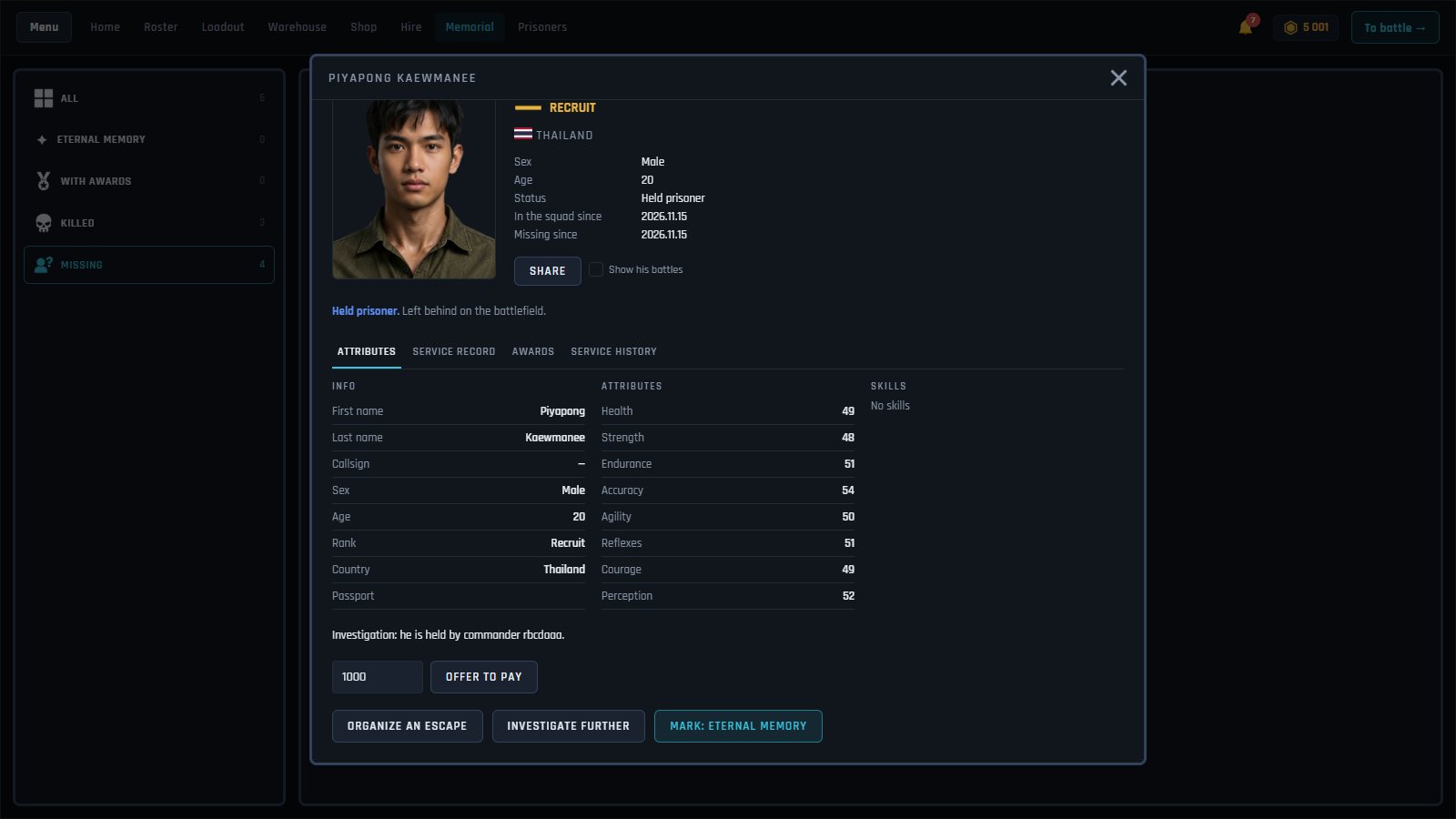
Ransom. The commander names a price; the prison’s holder accepts or refuses. The holder can make the first offer too, if the prisoner named their commander under interrogation; if that name was a lie, the offer goes nowhere. The holder can lie that they don’t have the soldier, and the card then opens for investigation again. Nobody pays for an AI soldier, so there is no ransom for one.
An organised escape. The commander pays for a hidden pistol with one magazine to be passed to the prisoner, who then runs armed. Whether the pistol gets through depends on luck and the organiser’s intelligence skill. If it does, the same escape battle begins, except the commander controls the runner, not the AI.
An assault on the prison. The commander picks a fireteam, and the holder is warned a minute before the start. The assault is closed for rework at the moment and isn’t available to players.
One operation per prison every few days. If the battle could not be created, the money comes back.
Reputation
Before a battle the intel on your opponent sometimes shows how many prisoners they have taken, released and killed, and what share of the wounded they finished off. Each line is confirmed with a small probability, so you never get the full picture, but a commander who shoots prisoners becomes known sooner or later. The premium for a prisoner is higher than for a kill: taking someone alive is harder.
What’s rough
The balance hasn’t been checked on live players. Escape, interrogation and recruitment chances, investigation time, prices and the workshop’s output are initial numbers and will change. The assault is closed. Prisoners say nothing yet about their former organisation, and there is nobody to pay a ransom for an AI soldier.
A battle with a friend is still a training battle, and nobody is captured in it. Captivity can be tried in an ordinary battle against the AI or a live opponent, and the demo battle against a bot is open with no signup: /play/?screen=demo